
Cubes & Liquids
 What is Cubes & Liquids?
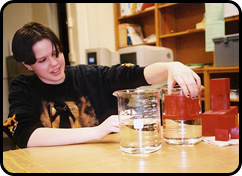
Cubes & Liquids is an assessment activity involving a sequence of immersions of cubes in liquids with some unexpected results. Students are challenged to apply their knowledge and skills in order to:
- make careful observations,
- turn these observations into rigorous predictions,
- organize and justify their predictions, and
- consider properties of the cubes and liquids to explain the phenomenon of floating and sinking.
Who is Cubes & Liquids for?
Cubes & Liquids is a challenging task for graduating high school seniors and engages 6th graders at all ability levels, too. It provides motivation and foundational knowledge related to core scientific concepts and skills.
Where did Cubes & Liquids come from?
Cubes & Liquids is the result of combining ideas from several sources:
- Cubes & Liquids grew out of Inhelder and Piaget’s (1954) developmental studies of children’s understanding of floating and sinking.
- The classroom version was inspired by a laboratory exercise created by Cindy Sargent, a Troy, New York earth science teacher who used the lab to teach density of solids and liquids, careful observation skills and critical thinking.
- ACASE research on the discovery of scientific concepts by high school students (Zachos, Hick, Doane & Sargent, 2000).
Why do we use it?
Cubes & Liquids is designed for practical use in the classroom. It has been administered to groups ranging from 1 to 60 individuals. It takes approximately 30 minutes to administer and 2-3 minutes per student to rate performance. The ratings then become part of a broad picture of individual student and class performance over time.
Why these learning goals?
Worthy learning goals are typically identified by panels of qualified stakeholders (e.g., teachers, educational researchers, scientists) through consensual validation processes and result in documents such as the National Science Standards, the AAAS Benchmarks and various state documents. Learning goals may also be identified empirically (Zachos et al, 2000). Additionally, these learning goals are aligned with New York State Standards for Math Science and Technology.
Stories that have been used with Cubes & Liquids
A variety of stories taken from the history of science and civilization might be used to introduce the Activity. Stories motivate students by connecting the activity to real world experiences and to historical figures with whom students may already be familiar. They create a relaxed classroom atmosphere in which the experience can be fully appreciated.
The story currently included in the teacher instructions (PDF, 250KB) is the story of how Socrates became a philosopher. This introduces students to a man with a profound bent toward inquiry and to his application and constructive use of the notion of uncertainty. In Cubes & Liquids students will need to consider when there is insufficient information to make a good prediction. The realization that there is insufficient information to make an accurate prediction is a powerful indicator of competence in coordinating mass and volume in conceptualizing density, as well as of the students’ ability to engage in open-ended inquiry. In other words they must discover and become secure, as Socrates did, in the value of knowing when they don’t know.
- Learning Goals
- Technical Report on Cubes & Liquids (v4)
- Teacher Instructions for Administering Cubes & Liquids (PDF)
- Student Response Form (PDF)
- Cubes & Liquids Scoring Guide (PDF)
- New York State Standards Alignment (PDF)
References
AAAS. (1993).
Benchmarks for Science Literacy. New York: Oxford University Press.
National Research Council. (1996).
National science education standards. National Academy of Sciences: National Academy Press.
Inhelder, B. and Piaget, J. (1958).
The growth of logical thinking from childhood to adolescence. New York: Basic Books.
Inhelder, B. and Piaget, J. (1964).
The early growth of logic in the child. New York: Basic Books.
Zachos, P., Hick, T., Doane, W., & Sargent, C. 2000.
Setting Theoretical and Empirical Foundations for Assessing Scientific Inquiry and Discovery inEducational Programs. The Journal of Research in Science Teaching, 37(9), 938-962.